

Brochure Content Strategy in Hyderabad: 12 Sections That Turn Readers Into Enquiries
Brochure Content Strategy in Hyderabad: 12 Sections That Turn Readers Into Enquiries
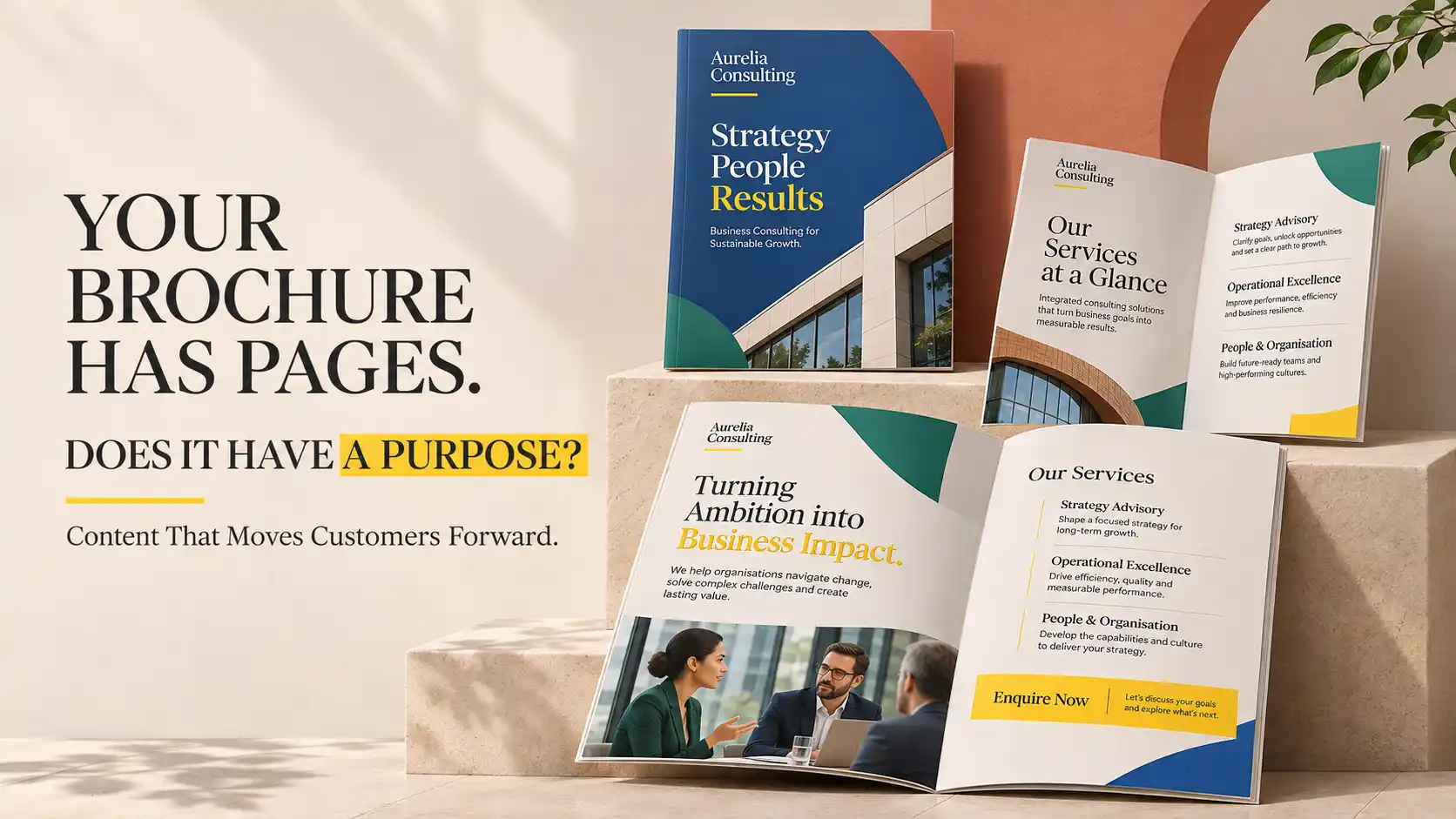
A beautifully designed brochure can attract attention, but attractive graphics alone may not convince a potential customer to contact your business. The information inside the brochure needs to answer important questions, communicate relevant benefits and guide readers towards a clear next step.
Whether you are presenting manufacturing capabilities, property developments, healthcare services, educational courses or corporate solutions, a structured Brochure Content Strategy in Hyderabad can help transform a collection of company information into a more useful sales communication tool.
At Designers Studio, we approach professional brochure design through content hierarchy, visual storytelling, brand consistency and practical customer communication.
Why Does Brochure Content Matter?
A brochure is often used when customers need more information than a short advertisement can provide.
During a sales meeting, exhibition or business presentation, a brochure may help explain services, compare products or introduce a company to potential customers.
Readers may also review the brochure later or share it with colleagues and decision makers.
If the content is poorly organised, customers may struggle to understand the offer even when the design looks attractive.
Professional Business Brochure Content Hyderabad should therefore focus on the questions customers need answered before making an enquiry.
Good brochure content does not guarantee sales. However, it can make the buying process clearer and reduce unnecessary confusion.
Brochure Design vs Brochure Content Strategy
Brochure design concerns the visual presentation of information, including layout, typography, photography, colors and page composition.
Brochure content strategy determines which information should appear, how it should be organised and what the reader should understand after reviewing it.
These activities work together.
A brochure containing excellent information may still be difficult to read if the layout is overcrowded.
Similarly, an attractive brochure with vague headlines and generic descriptions may fail to explain the business effectively.
The strongest approach connects useful content with clear visual communication.
1. Start With a Strong Cover Headline
The brochure cover should communicate the main subject quickly.
Simply placing the company name and the words “Company Brochure” may not explain why a potential customer should continue reading.
A more useful headline identifies the service, product category or central customer benefit.
Example
Instead of “Our Manufacturing Company”, an industrial supplier might use “Precision Components for Demanding Industrial Applications”.
The headline should remain accurate and relevant to the company’s actual capabilities.
Design Tip
Keep the cover focused on one clear message, supported by a strong photograph or distinctive graphic concept.
2. Write a Clear Company Introduction
The introduction should explain who the company is, what it provides and which customers it serves.
Many brochures use lengthy paragraphs filled with generic claims about excellence, innovation and customer satisfaction.
These statements are less useful when they do not provide specific information.
A stronger introduction can identify the company’s industry, location, relevant experience and principal services.
Example
“We manufacture custom metal components for industrial equipment companies, supporting prototype development and production requirements.”
This gives the reader a clearer understanding of the business.
3. Explain the Customer Problem
Potential customers are usually looking for a solution to a specific requirement.
Before presenting every product or service, explain the situations in which customers may need your business.
A commercial equipment company might address maintenance difficulties, replacement requirements or equipment compatibility.
A training academy might explain the practical skills students need before entering an industry.
The objective is to demonstrate understanding of the customer’s situation without exaggerating the problem.
4. Present Your Product or Service as a Clear Solution
After identifying the customer’s requirement, explain how your business addresses it.
Organise products and services into understandable categories rather than placing everything in one long paragraph.
Use concise descriptions that explain what is offered, who it is suitable for and what the customer should expect.
For complex services, a short process diagram or structured comparison can make the information easier to understand.
Design Tip
Use distinct headings, consistent layouts and relevant imagery to separate different offerings.
5. Communicate Customer Benefits, Not Only Features
Features explain what a product or service includes. Benefits explain why those features matter to the intended customer.
Both can be useful in a professional brochure.
For example, an equipment manufacturer may list material specifications as features and explain their relevance to particular operating requirements.
A website design company may describe responsive layouts as a feature and explain that they support usability across different screen sizes.
Benefits should be realistic and supported by the product or service’s actual capabilities.
6. Include Relevant Product Specifications and Service Details
Some brochures are primarily intended to introduce a company. Others need to help customers compare technical options.
The amount of detail should match the intended audience.
Manufacturers may need specifications, dimensions, materials or application information.
Educational institutions may need course duration, eligibility and curriculum details.
Real estate brochures may need verified property information, plans, amenities and location details.
Information should be accurate, current and presented in a format readers can scan easily.
7. Build Credibility With Relevant Proof
Customers may want reassurance that the company can deliver what it promises.
Credibility can be supported through verified project examples, relevant certifications, genuine customer testimonials, case studies or documented capabilities.
Not every brochure needs all these elements.
Select the evidence that matters most to the intended reader.
A manufacturing company may benefit from facility photographs and verified quality certifications, while a design agency may benefit from examples of completed work.
Avoid invented testimonials, unsupported statistics or claims that cannot be substantiated.
8. Explain How Your Business Works
A short process section can help customers understand what happens after they contact the company.
For a service business, this might include consultation, requirements gathering, proposal, execution and delivery.
For a manufacturer, it may describe enquiry, specification review, quotation, production and dispatch.
Explaining the process can make the next step feel more understandable.
Design Tip
Use a clear numbered sequence with short descriptions rather than a complicated diagram.
9. Use Photography That Supports the Message
Images should help explain the business rather than simply fill empty spaces.
Real photographs of products, facilities, teams or completed projects can provide useful context when they are accurate and professionally presented.
Stock photography may be appropriate for some conceptual applications, but it should not be used in ways that misrepresent the company’s actual facilities or work.
Consistent lighting, composition and image quality also help create a more professional presentation.
When several images are used, choose photographs that add different information rather than repeating similar views.
10. Answer Important Customer Questions
A brochure can address questions that commonly arise during sales discussions.
Depending on the industry, these may concern service availability, customisation, delivery areas, product compatibility, project requirements or consultation procedures.
Answering relevant questions can help customers decide whether to make an enquiry.
Keep the section concise and avoid including information that changes frequently unless the brochure can be updated easily.
11. Include a Clear Call to Action
A brochure should tell interested readers what they can do next.
The call to action should reflect the intended purpose of the document.
Examples include “Request a Quotation”, “Schedule a Consultation”, “Explore Our Product Range” or “Contact Our Sales Team”.
A brochure created for a trade exhibition may use a different call to action from one distributed during a client presentation.
Keep the instruction direct and make the contact method easy to find.
12. Make Contact Information Easy to Find
Readers should not need to search through several pages to find the company’s contact details.
Depending on the business, the brochure may include a phone number, email address, website, office location or relevant enquiry link.
Digital brochures can use clickable links, while printed brochures may use a QR code directing customers to a suitable page.
QR codes should be tested before printing, and their destination should remain appropriate for the intended audience.
Check every contact detail during the final proofreading stage.
How Should Brochure Content Change by Industry?
Manufacturing and Industrial Businesses
Prioritise capabilities, product categories, technical specifications, manufacturing information and verified quality credentials.
Real Estate Companies
Focus on verified project details, location, plans, amenities, specifications and the appropriate enquiry process. Ensure legally required disclosures are reviewed.
Healthcare Businesses
Explain available services, practitioner qualifications where relevant, appointment information and patient guidance. Avoid unsupported medical claims.
Educational Institutions
Present course information, eligibility, duration, learning outcomes, facilities and admission procedures accurately.
Corporate Service Providers
Communicate the business problem, services, working process, relevant experience and clear next steps.
A professional Corporate Brochure Design Hyderabad project should reflect the decisions customers need to make within the particular industry.
How to Arrange Content in an Eight Page Corporate Brochure
An eight page brochure can provide enough space for a concise company introduction and selected service information without becoming an extensive catalogue.
| Page | Recommended Content |
|---|---|
| 1 | Cover headline and brand introduction |
| 2 | Company overview and positioning |
| 3 | Customer needs and principal solutions |
| 4 | Core products or services |
| 5 | Additional capabilities and customer benefits |
| 6 | Project examples and relevant credibility |
| 7 | Working process and common questions |
| 8 | Contact information and call to action |
This is an illustrative structure, not a fixed rule. The appropriate sequence depends on the content volume, audience and brochure format.
Common Brochure Content Mistakes to Avoid
One common mistake is opening with a long company history before explaining what the business actually provides.
Another is using generic promotional language instead of useful product and service information.
Brochures can also become difficult to read when too many unrelated messages compete on the same page.
Other problems include inconsistent terminology, outdated specifications, unsupported claims, low quality photography and missing calls to action.
Finally, businesses should avoid approving a brochure without proofreading names, numbers, addresses and important technical details.
Our Brochure Design Approach at Designers Studio
Understanding the Audience
We begin by identifying who will read the brochure and what they need to understand.
Content Organisation
Company information, products, services and supporting details are arranged into a logical sequence.
Creative Direction
Typography, imagery, color and visual hierarchy are developed around the brand and brochure requirements.
Page Layout Development
Content is presented through consistent grids, clear headings, balanced spacing and suitable visual elements.
Review and Refinement
Layouts are reviewed for readability, consistency and practical communication.
Final Artwork Preparation
Approved brochure artwork is prepared for digital use or professional printing according to the agreed scope.
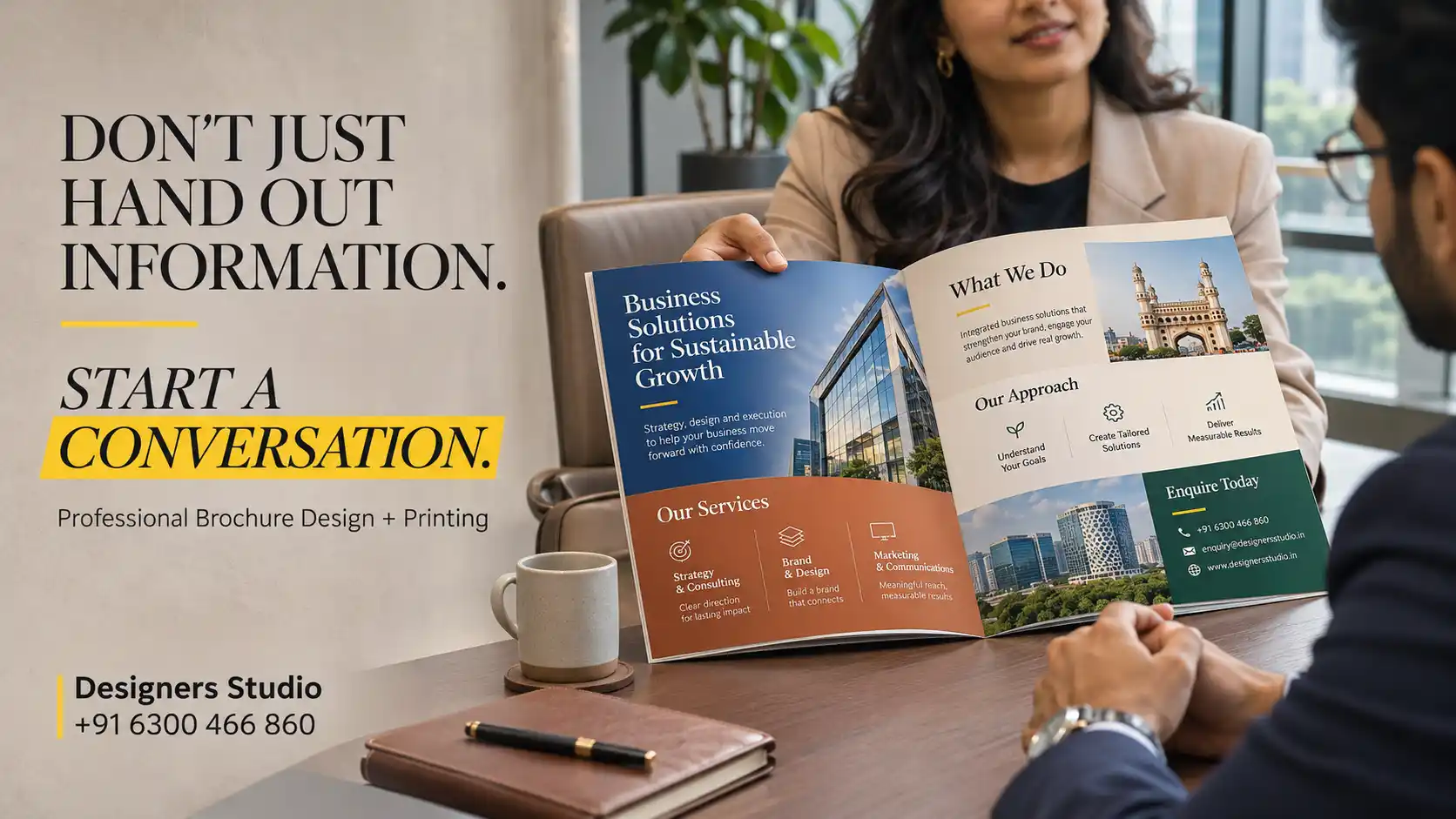
Businesses can explore our brochure design and printing services in Hyderabad or combine brochure development with our graphic designing services.
Why Choose Designers Studio for Brochure Design in Hyderabad?
Designers Studio provides graphic design and printing services for businesses across Hyderabad and Telangana.
Established in 2012 and based in LB Nagar, the studio supports business communication through brochures, brand identities and other marketing materials.
Our approach to Brochure Content Strategy in Hyderabad focuses on connecting useful information with professional visual presentation.
Whether the requirement is a corporate brochure, service brochure, product introduction or sales presentation, the content and layout should support the brochure’s intended purpose.
Frequently Asked Questions
What content should a business brochure include?
A business brochure should generally include a clear introduction, relevant products or services, customer benefits, useful supporting information, credibility elements and an easy way to make an enquiry.
How can brochure content help generate enquiries?
Clear brochure content can help customers understand the offer, evaluate relevant information and identify the next step. Results also depend on the audience, distribution method and wider sales process.
How many pages should a corporate brochure have?
The appropriate page count depends on the amount of information, audience and brochure purpose. A concise brochure may need only a few panels, while a detailed corporate presentation may require multiple pages.
Should brochures focus on product features or benefits?
Both can be important. Features explain the product or service, while benefits explain why those features matter to the intended customer. The right balance depends on the audience.
Does Designers Studio provide brochure design and printing in Hyderabad?
Yes. Designers Studio offers brochure design and printing services for businesses in Hyderabad. Companies can contact the studio to discuss their brochure format, content and printing requirements.
Conclusion
A professional brochure should do more than display attractive photographs and company information.
It should help customers understand the business, evaluate relevant offerings and identify a clear next step.
Developing a thoughtful Brochure Content Strategy in Hyderabad allows businesses to connect their sales messages with appropriate visual design.
Designers Studio supports businesses across Hyderabad and Telangana with professional brochure design and printing solutions developed around practical communication requirements.
YOUR BROCHURE SHOULD DO MORE THAN LOOK GOOD.
Give customers the information they need to understand your business and take the next step.
Designers Studio
LB Nagar, Hyderabad
Phone: +91 6300 466 860
Email: info@designersstudio.co.in
