

Packaging Design for Small Businesses in Hyderabad
Packaging Design for Small Businesses in Hyderabad: 12 Essentials Before Printing
A customer may discover your product on a supermarket shelf, through an online marketplace or while browsing a quick commerce application. In each situation, packaging influences how the product is presented, identified and understood. Effective packaging must do more than look attractive. It should communicate essential information, reflect the brand, suit the product and work with the chosen printing and packaging materials.
Understanding Packaging Design for Small Businesses in Hyderabad helps manufacturers, retailers, food brands, cosmetic businesses and growing product companies avoid expensive design and production mistakes. At Designers Studio, we approach product packaging graphics through visual identity, typography, communication hierarchy and practical production requirements.

Why Does Packaging Design Matter for Small Businesses?
Packaging is one of the most visible parts of a physical product.
Customers may see the package before they experience the product itself. Its design can help communicate the product category, intended audience, brand personality and key information.
For a small business, consistent packaging can also help connect multiple products under one recognisable brand.
However, visual appearance is only one requirement. Packaging must also accommodate product information, material limitations, handling requirements and relevant regulations.
Professional Product Packaging Design Hyderabad should balance communication, appearance and practical production needs.
Packaging Design vs Label Design: What Is the Difference?
Packaging design covers the broader presentation of a product, which may include its container, box, pouch, sleeve, structure and printed graphics.
Label design focuses on the information and graphics applied to a product or container.
For example, a cosmetic product may require both a bottle label and a printed outer carton.
A food manufacturer may need a flexible pouch with graphics printed directly onto the material.
Businesses should clarify whether they need graphic artwork, structural packaging development, label design or a combination of these services.
1. Understand Your Target Customer
Before developing a packaging concept, identify who is most likely to buy the product.
Consider customer needs, purchasing environment, product positioning and price category.
Packaging for a premium skincare product may require a different visual approach from packaging for a daily household essential.
The objective is not to imitate every design convention within the industry. It is to communicate appropriately to the intended customer.
Practical Tip
Prepare a short packaging brief explaining the product, customer, main benefits, sales channels and desired brand personality.
2. Research Competing Products
Competitor research helps businesses understand the visual environment in which their products will appear.
Review competing packaging for typography, colors, imagery, information hierarchy and packaging formats.
Look for common design patterns as well as opportunities for differentiation.
A design should feel appropriate to its product category without becoming unnecessarily similar to competing brands.
Practical Tip
Compare your proposed packaging with several products that customers are likely to consider alongside yours.
3. Create a Clear Packaging Information Hierarchy
Not every piece of information on a package should have the same visual importance.
The brand name, product name, product variant and essential identifying information should be arranged according to the customer’s needs.
Supporting details should remain readable without competing unnecessarily with the main message.
Overcrowding the front panel with excessive claims, icons and decorative text can make the product difficult to understand.
Practical Tip
Review the package at actual size and from a typical viewing distance to determine whether the main information is immediately understandable.
4. Choose Typography That Remains Readable
Typography influences both packaging personality and usability.
A distinctive display typeface may be suitable for the product name, while supporting information may require a simpler font.
Very thin letters, excessive decorative styles and inadequate contrast can create readability problems.
Small text should also be checked against the final print size and applicable legal requirements.
Practical Tip
Test important information on a physical print sample instead of relying only on a zoomed computer screen.
5. Select a Suitable Packaging Color System
Color can help establish brand recognition and distinguish product variants.
However, color decisions should consider the target customer, category, printing method and surrounding product environment.
A brand selling multiple variants may use a consistent visual structure with controlled color changes.
Different materials and printing processes can affect how colors appear in the finished package.
Practical Tip
Approve printed color proofs where color accuracy is important, particularly when using different packaging suppliers.
6. Choose Packaging Materials Carefully
Packaging material affects appearance, protection, handling and production requirements.
Possible formats include paperboard cartons, rigid boxes, labels, flexible pouches, sleeves and other product appropriate structures.
Material selection should account for the product’s physical characteristics, storage conditions, transport and intended use.
Food, cosmetic, chemical and other regulated products may require specialised packaging considerations.
Practical Tip
Confirm material suitability with the packaging manufacturer or qualified specialist before finalising the graphics.
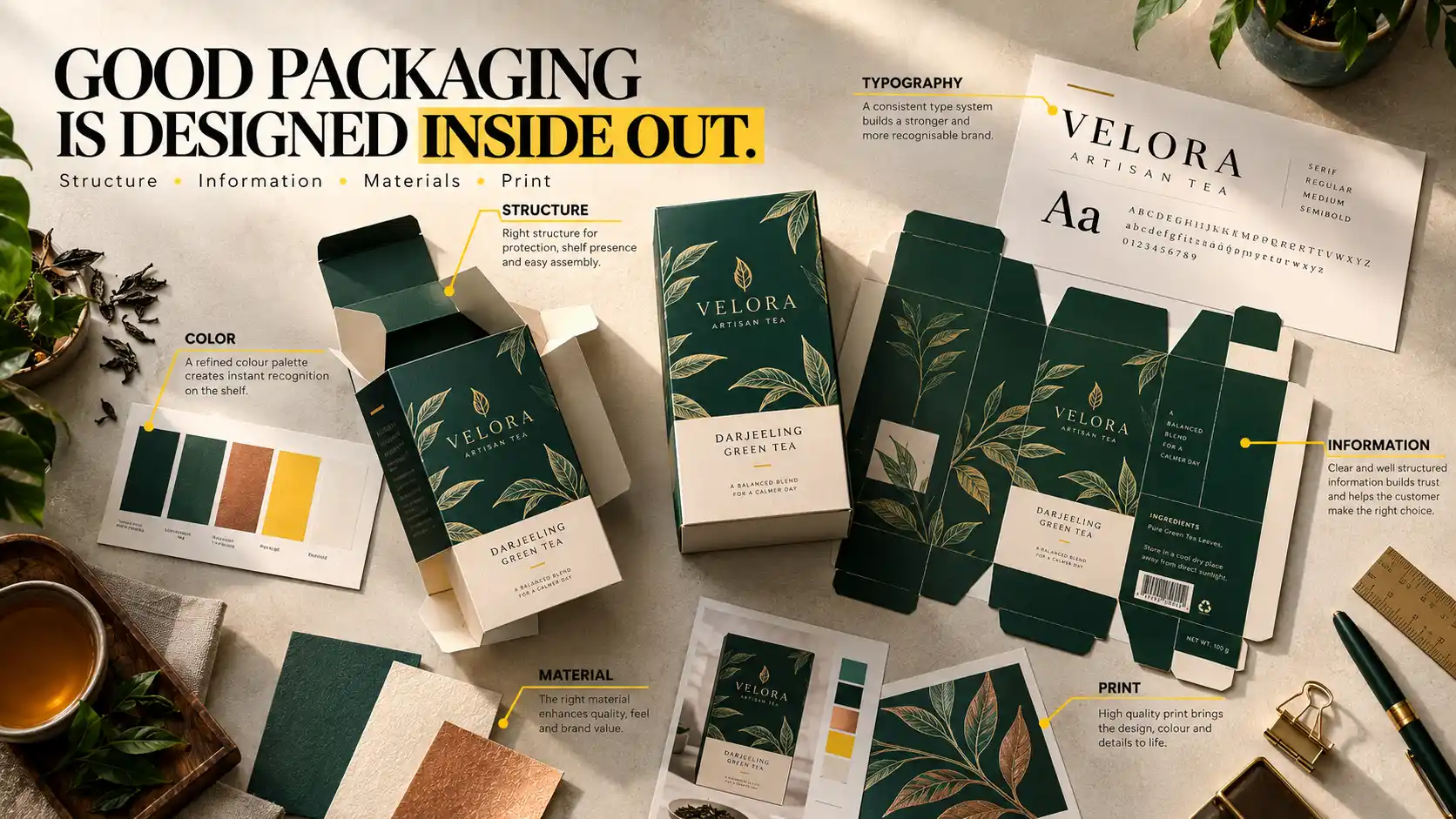
7. Prepare Accurate Packaging Dielines
A dieline is a technical layout indicating the cutting, folding and other structural boundaries of packaging artwork.
It helps the designer position graphics correctly on the final package.
Artwork that ignores folds, seams, seals or cutting boundaries may become distorted or lose important information during production.
Accurate dimensions are particularly important when artwork must fit a manufacturer’s existing packaging structure.
Practical Tip
Request the approved dieline from the packaging supplier before preparing final production artwork. Confirm bleed, safe areas and other specifications with the printer.
8. Include Required Product Information
Packaging often needs to communicate more than the product name and brand identity.
Depending on the category, applicable requirements may include product quantity, manufacturer or marketer details, batch information, dates, instructions, warnings, ingredient information or other declarations.
In India, requirements may arise from laws and regulations applicable to the specific product category, including legal metrology, food safety or other sector specific rules.
Designers should not assume that one information template is suitable for every product.
Practical Tip
Have the final packaging content reviewed by the responsible regulatory or compliance professional before printing. Graphic design approval is not a substitute for regulatory approval.
9. Maintain Consistency Across Product Variants
A company may sell different flavors, sizes, fragrances, models or product categories.
Each package should remain identifiable as part of the same brand while making its individual variant clear.
A coordinated system can use consistent logo placement, typography, grid structure and supporting graphics.
Variant differentiation may be achieved through carefully selected colors, product names, photography or other approved visual elements.
Practical Tip
Design a flexible packaging system before expanding into multiple product variants.
10. Design for Physical Retail and Online Shopping
Packaging may need to work in several purchasing environments.
In a physical shop, customers may view products from a distance or compare several packages together.
Online, the product may first appear as a small image on a mobile screen.
Important identifying information should remain clear in both situations.
Businesses selling through e-commerce and quick commerce platforms should also consider product photography and marketplace image requirements.
Practical Tip
Test the package in a realistic shelf arrangement and as a small product listing thumbnail.
11. Check Print Production Requirements
Packaging graphics must be prepared according to the specifications of the selected printer and material.
Production considerations can include bleed, color profiles, image resolution, font handling, barcode placement and special finishes.
Artwork may also require separate layers or technical markings for varnish, foil, embossing, cutting or other processes.
These requirements vary between production methods.
Practical Tip
Obtain written artwork specifications from the packaging printer before exporting final files.
12. Test the Packaging Before Bulk Printing
A digital mockup can help visualise the design, but it cannot fully reproduce every physical production characteristic.
A printed sample can reveal problems with readability, alignment, color, folds, material finish and product fit.
Where appropriate, businesses should also verify practical handling and durability with the packaging supplier.
Testing is especially important when producing a new structure or ordering large quantities.
Practical Tip
Review and approve a physical sample or production proof before committing to bulk manufacturing whenever the production process allows.
Common Packaging Design Mistakes Small Businesses Should Avoid
One frequent mistake is designing artwork before confirming the package dimensions.
Another is adding too much information to the front panel without a clear hierarchy.
Businesses may also choose colors and finishes without considering the printing process.
Using inconsistent logo versions across product variants can weaken the visual connection between products.
Other mistakes include placing text too close to cutting or sealing areas, using unreadable typography and overlooking category specific information requirements.
Finally, approving a design only through digital mockups can allow production problems to remain unnoticed until printing.
Packaging Design Checklist Before Printing
- Confirm the correct product name and variant.
- Use approved logo artwork and brand colors.
- Check typography and readability at actual size.
- Verify packaging dimensions and supplier dielines.
- Review cutting, folding, sealing and safe areas.
- Confirm the required product declarations.
- Check barcode placement and scanning where applicable.
- Review image resolution and printer specifications.
- Test the design on realistic product mockups.
- Approve a suitable physical or production proof.
Completing these checks can reduce avoidable artwork errors before production.
Our Packaging Graphic Design Approach at Designers Studio
Product and Business Discovery
We begin by understanding the product, target customer, brand identity and intended packaging applications.
Competitor and Visual Research
Relevant product categories are reviewed to establish a suitable visual direction.
Packaging Concept Development
Typography, color, imagery and layout directions are explored according to the approved brief.
Artwork Development
Selected concepts are refined around the supplied packaging dimensions and relevant technical specifications.
Visual Application Review
Packaging graphics can be evaluated through realistic mockups and product presentation examples.
Production Artwork Preparation
Final graphic files are prepared according to the agreed scope and printer requirements.
Businesses requiring broader communication support can also explore our graphic designing services in Hyderabad and brochure design and printing services.

Why Choose Designers Studio for Packaging Graphic Design in Hyderabad?
Designers Studio creates professional visual communication and branding materials for businesses across Hyderabad and Telangana.
Our design approach considers typography, color, layout, brand consistency and practical application requirements.
For businesses exploring Packaging Design for Small Businesses in Hyderabad, a clear project brief helps establish whether the requirement involves labels, printed packaging graphics, product variants or a broader visual identity system.
Packaging structure, material engineering, regulatory approval and manufacturing should be coordinated with the appropriate qualified suppliers and specialists.
Frequently Asked Questions
What is included in professional packaging graphic design?
Depending on the project scope, packaging graphic design can include visual concepts, typography, color systems, label layouts, product variant designs, mockups and print ready artwork based on approved packaging specifications.
What is the difference between packaging design and label design?
Packaging design may cover the broader container, structure and visual presentation, while label design focuses on the graphics and information applied to a package or product container.
Why is a packaging dieline important?
A dieline identifies structural boundaries such as cuts, folds and other production areas. It helps designers position graphics correctly for the intended packaging format.
Should small businesses test packaging before bulk printing?
Yes. Physical samples and production proofs can help identify problems with color, readability, alignment, material finish and package construction before larger quantities are manufactured.
Can Designers Studio help with packaging graphics in Hyderabad?
Businesses can contact Designers Studio to discuss packaging graphics, product labels, branding and related visual design requirements. The exact services and deliverables should be confirmed for the individual project.
Conclusion
Effective product packaging is developed through a combination of visual communication, brand consistency, technical preparation and practical testing.
From typography and color to dielines, product information and printing requirements, every important decision contributes to the finished package.
Understanding Packaging Design for Small Businesses in Hyderabad helps businesses prepare more confidently before investing in printed packaging.
Designers Studio supports businesses across Hyderabad and Telangana with professional graphic design and visual branding solutions developed around their individual requirements.
YOUR PRODUCT DESERVES BETTER PACKAGING.
From product labels to coordinated packaging graphics, build a visual identity that communicates clearly and looks professional.
Designers Studio
LB Nagar, Hyderabad
Serving Hyderabad and Telangana
Phone: +91 6300 466 860
Email: info@designersstudio.co.in
