
What is a Brochure? The Ultimate Guide to Meaning, Examples, & Uses
What is a Brochure? The Ultimate Guide to Meaning, Examples, & Uses
In a world dominated by scrolling feeds, 15-second reels, and fleeting digital ads, you might pause and ask: “Does paper still have power?” The answer is a definitive yes. When a potential client walks into a high-end real estate office in Banjara Hills or attends a corporate summit at Hitech City, they aren’t just looking for a website link—they are looking for substance. They want something they can hold, read, and trust.
This is where the humble brochure transforms into a business powerhouse. But what is a brochure exactly? Is it just a folded piece of paper, or is it a strategic asset that acts as a silent salesperson for your brand? As the leading Brochure Design Company in Hyderabad, Designers Studio has crafted thousands of these marketing tools. We know that a well-designed brochure bridges the gap between digital interest and physical sales.
In this extensive guide, we will move beyond the dictionary definition. We will explore the deep meaning, real-world examples, and critical uses of brochures that can skyrocket your brand authority in the competitive Telangana market.
What is a Brochure? Deep Dive into Meaning and Definition
To truly understand what is a brochure, we must look at it from two perspectives: the physical and the functional.
The Physical Definition
Technically, a brochure is an informative paper document that can be folded into a template, pamphlet, or leaflet. Unlike a flyer, which is a single flat sheet used for high-volume distribution, a brochure is folded to create multiple panels or pages. It is usually printed on higher-quality paper stock (glossy, matte, or textured) to convey value.
The Marketing Definition
Functionally, a brochure is a vital marketing tool used to introduce a company, organization, product, or service to a target audience. It is a “takeaway” item. It allows your customer to take your brand home with them. While a website requires an internet connection and a device, a brochure requires only eyes and hands. It is accessible, permanent, and personal.
Think of a brochure as a hand-held website. It delivers your core message, your visual identity (like your Logo Design), and your call-to-action in a compact, organized format.
The Psychology of Touch: Why Brochures Still Work
Before we discuss the types and examples, it is crucial to understand why we still use them in 2025. It comes down to “Haptic Memory”—the memory of touch.
Studies in consumer psychology show that physical media leaves a deeper footprint in the brain than digital media. When a customer in LB Nagar holds a textured, well-printed brochure, their brain subconsciously associates the weight and quality of the paper with the quality of your services. If the paper feels cheap, the service feels cheap. If the brochure feels premium with Spot UV coating, the brand feels premium. This tactile experience is something a Facebook ad simply cannot replicate.
The 5 Major Uses of a Brochure in Business
When clients ask us what is a brochure used for, the answer varies by industry. However, almost all successful brochures fall into one of these five categories:
1. Direct Mail and Targeted Marketing
Brochures are the kings of direct mail. Whether you are a local gym in Dilsukhnagar sending offers to nearby residents, or a B2B software firm in Madhapur sending specs to IT managers, a brochure delivered by mail has a much higher open rate than a cold email. It lands on their desk, not in their spam folder.
2. The “Leave-Behind” Asset
After a sales meeting, you never want to leave empty-handed. Leaving a brochure behind ensures that your pitch continues even after you have left the room. It gives the client something to discuss with their team or partners later. It serves as a reminder of your professionalism.
3. Point of Sale (POS) Information
Have you seen the racks of folded papers at bank counters or travel agencies? These are POS brochures. They capture the attention of people who are already interested and waiting. They answer specific questions like “What are the interest rates?” or “What is included in the Bali tour package?” without occupying a staff member’s time.
4. Educational & Technical Support
Not all brochures are for selling; some are for teaching. Hospitals use them to explain post-surgery care. Tech companies use them to explain installation steps. This builds trust by showing you care about the customer’s success, not just their money.
5. Menus and Service Lists
For restaurants, spas, and salons, a brochure often doubles as a menu. It lists services, prices, and descriptions in an appetizing, attractive layout. A well-designed menu brochure can actually increase the average order value by highlighting premium items.
Common Types of Brochures (With Examples)
The fold of the brochure dictates how the story is told. Different folds reveal information in different sequences. At Designers Studio, we help you choose the right format for your message.
1. The Tri-Fold Brochure
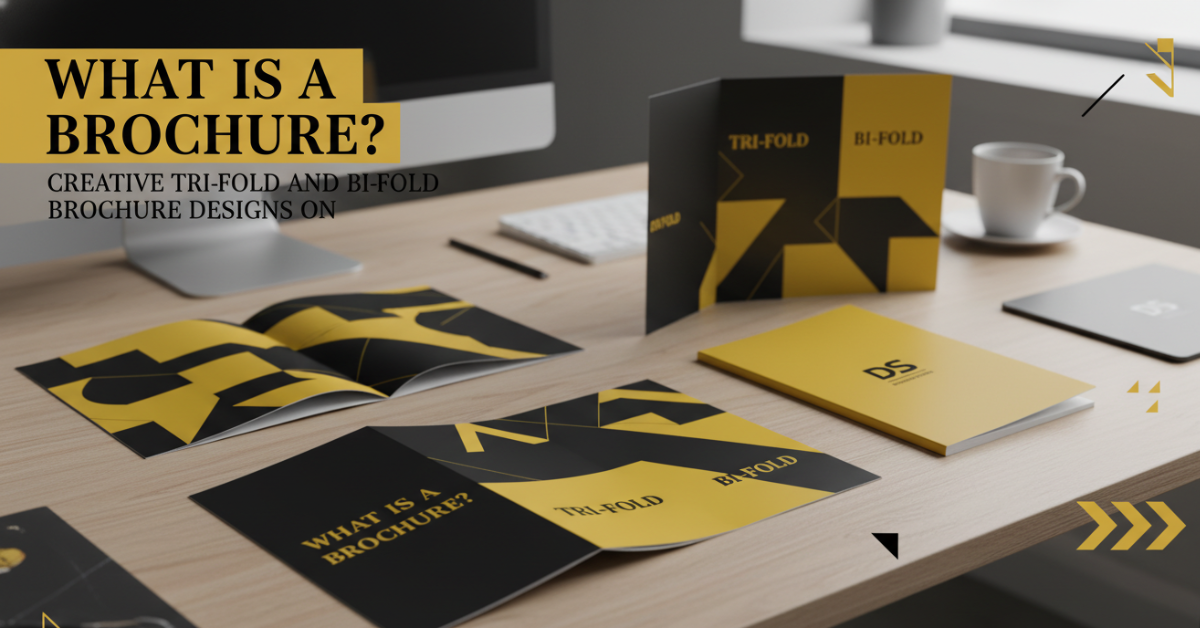
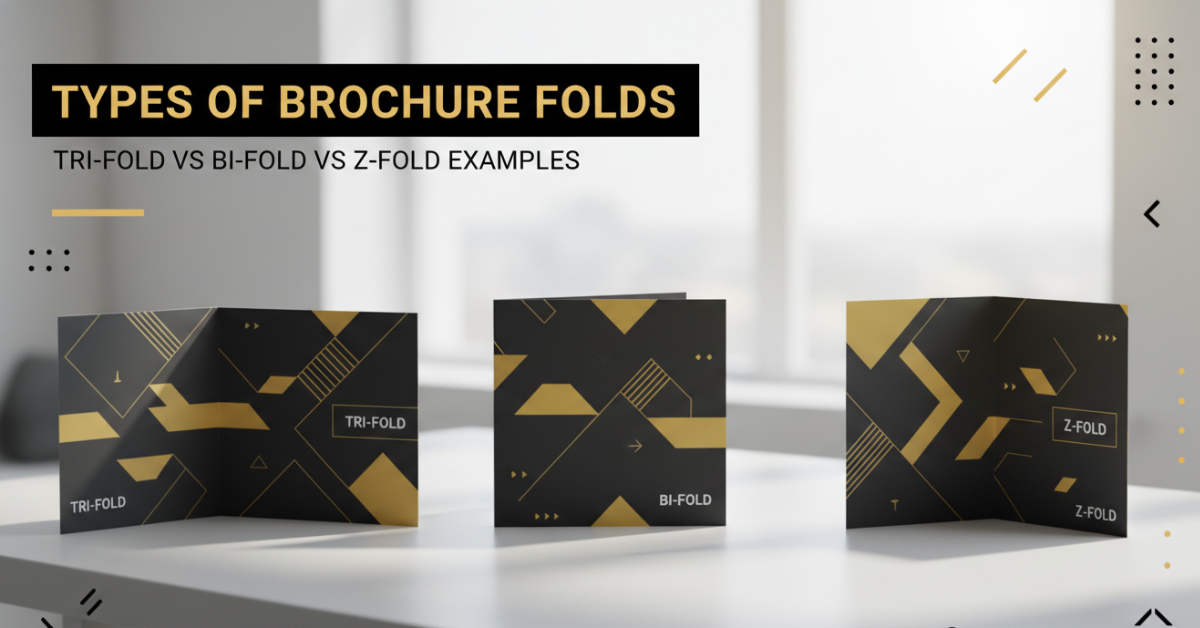
What is it? An A4 sheet folded twice to create three panels on each side (6 panels total).
Best Example: A cleaning service or pest control in Hyderabad.
Panel 1: Logo and Headline. Inside Panels: Services offered. Back Panel: Contact info.
Why use it? It is slim, fits in standard envelopes, and is cost-effective.
2. The Bi-Fold (Half-Fold) Brochure
What is it? A sheet folded once in the middle, like a book.
Best Example: A corporate annual report or a high-end product specification sheet.
Why use it? It offers a wider canvas for large images and reading ease. It feels more formal than a tri-fold.
3. The Gate-Fold Brochure
What is it? Two side panels open outwards (like a double door) to reveal a large central panel.
Best Example: Luxury Real Estate projects or Architecture firms.
Why use it? It creates a sense of “reveal” and drama. It is perfect for showcasing wide, panoramic images of building interiors or landscapes.
4. The Z-Fold Brochure
What is it? It folds like an accordion or the letter ‘Z’.
Best Example: A timeline of a company’s history or a step-by-step user guide.
Why use it? It encourages the reader to follow a sequence or narrative from one panel to the next naturally.
Brochure vs. Flyer vs. Pamphlet: Clearing the Confusion
Many business owners use these terms interchangeably, but in the professional design world, they are distinct. Understanding the difference helps you order the right product.
| Feature | Flyer | Brochure | Pamphlet |
|---|---|---|---|
| Structure | Single flat sheet (No fold) | Folded (Bi-fold, Tri-fold, etc.) | Often unbound booklet or folded |
| Purpose | Quick announcements, Events | Branding, detailed product info | Educational, non-commercial, political |
| Lifespan | Short (Throwaway after reading) | Long (Kept for reference) | Long (Reference material) |
| Paper Quality | Standard/Thin (80-100 GSM) | Premium/Card Stock (170-300 GSM) | Standard |
The Modern Evolution: The E-Brochure
We cannot discuss what is a brochure without mentioning its digital twin. In the post-pandemic era, the E-Brochure (Electronic Brochure) has become essential.
An E-Brochure is a PDF version of your physical brochure, optimized for screens. It often includes interactive elements like clickable links to your website, buttons to “Call Now,” or embedded videos. For businesses in Hyderabad operating on WhatsApp Business API, sending a high-quality E-Brochure is often the first step in the sales funnel. It allows you to reach customers instantly without printing costs.
Pro Tip: At Designers Studio, we recommend creating both. Use the E-Brochure for initial inquiries and the physical brochure for site visits and face-to-face closures.
What Goes Inside? The Anatomy of a Winning Brochure
Knowing what is a brochure is step one. Knowing how to fill it is step two. A brochure that looks good but says nothing is a waste of money. Here is the content formula we use:
- The Hook (Front Cover): A powerful headline and a stunning image. Do not just put your logo; put a benefit. Instead of just “Designers Studio,” write “Transforming Brands in Hyderabad.”
- The Meat (Inside Panels): Focus on benefits, not just features. Don’t just say “We have 24/7 support.” Say “Sleep easy knowing our team is watching your site 24/7.”
- The Proof (Testimonials): Add credibility. A short quote from a happy client works wonders.
- The Call to Action (Back Panel): Tell them what to do next. “Visit our Store,” “Scan QR Code,” or “Call for a Quote.”
Why Hyderabad Businesses Choose Designers Studio
Designing a brochure is an art that balances “Visual Appeal” with “Marketing Strategy.” You do not need a template; you need a custom solution.
At Designers Studio, located centrally in LB Nagar, we specialize in understanding the local market. We know what appeals to a techie in Gachibowli versus a wholesaler in Begum Bazar. We combine:
- High-Resolution Imagery: We ensure your photos are crisp and print-ready (300 DPI).
- Typography Hierarchy: We use fonts that guide the eye naturally through the content, ensuring readability for all ages.
- Color Psychology: We use colors that evoke the right emotions for your specific industry.
- Print Consulting: We don’t just design; we advise you on paper quality (GSM), matte vs. gloss finish, and spot UV options to ensure the final product looks million-dollar.
Frequently Asked Questions (FAQs)
Q1: How much information should I put in a brochure?
Q2: What is the standard size of a brochure?
Q3: How long does it take to design a brochure?
Q4: Do I need professional photos?
Q5: Can you design a brochure for WhatsApp sharing?
Conclusion
So, what is a brochure? It is your brand’s handshake. It is a storyteller, a navigator, and a closer. In the digital age, the tactile experience of a brochure offers a level of engagement that screens cannot match. It validates your business, educates your customer, and keeps your contact details right on their desk.
Whether you need a sleek digital catalogue for WhatsApp marketing or a premium embossed printed brochure, Designers Studio is here to bring your vision to life. Don’t let your business blend in. Stand out with a design that speaks volumes.
Start Your Brochure Design Journey Today
Get a free consultation with Hyderabad’s top creative team.
- 📞 Phone: +91 6300 466 860
- 📧 Email: info@designersstudio.co.in
- 📍 Location: Designers Studio, LB Nagar, Hyderabad